

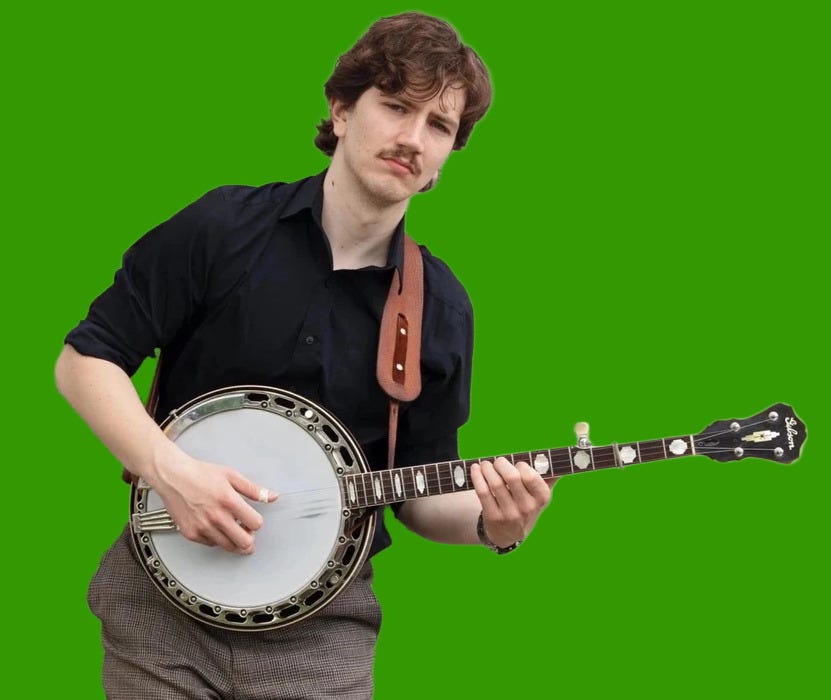
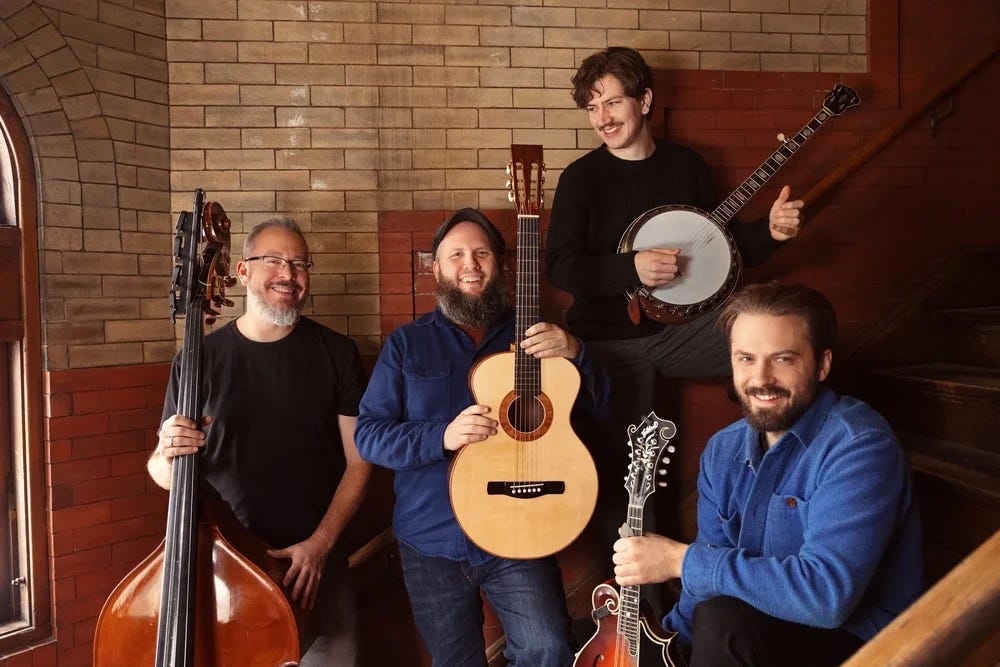
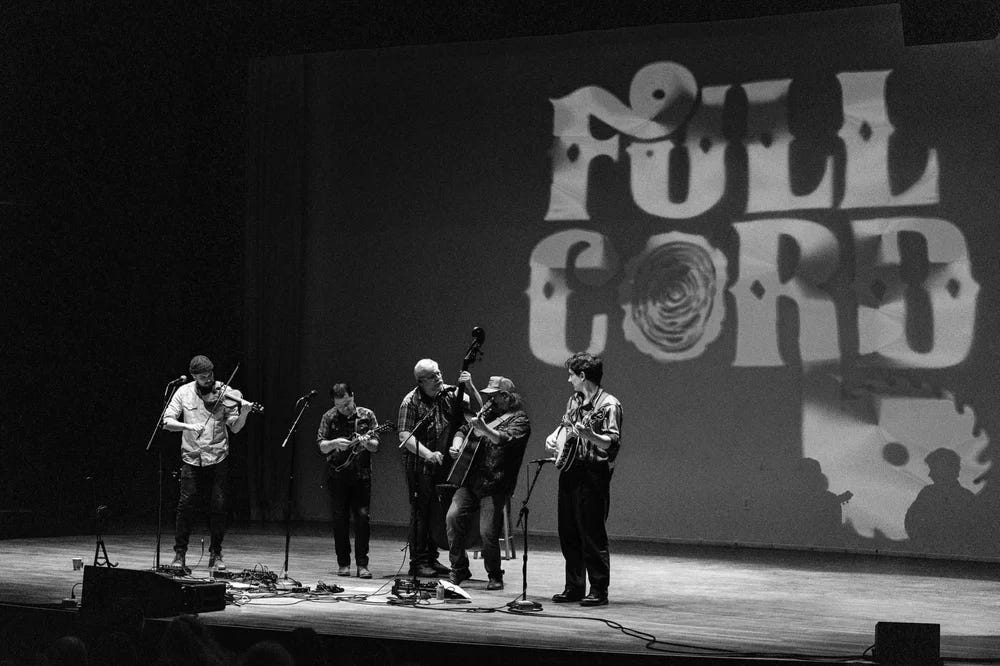
Max Allard’s banjoistic mind drinks from many disparate sources. And, having commingled and fermented them sufficiently, what he produces is something wildly unique. Forget trying to categorize it . . . his genre would have to be called something like contemporary bluegrass hard bop chamber music. (It’s all captured in the multi-instrumentalist's palindrome-friendly name: “Dr. All Ax, am I Max Allard?”) Better, perhaps, just to listen. His album Odes/Codes from several years ago is an astounding statement from a young man sure of the compositional path he’s chosen for himself and his banjo. The music is subtle, sublime, and may evoke emotions you didn’t know you had. He’s also the banjo player in the group EZRA (with Jacob Jolliff on mandolin), and their latest album features several Allard compositions that will sling your musical heart and mind to new corners. No wonder it’s called Whippersnap. Meanwhile, he lays down the groove for the Michigan hard-grass band Full Cord. Here we discuss the new EZRA album, his solo compositions, stealing milk, and how he does it all.
Banjo Head
You play plenty of straight-ahead bluegrass with Full Cord and others, but from an early age you were doing your own distinct thing. How did the banjo come to you in the first place, and how did you come to your way of playing and composing on it?
Max Allard
Yeah, so I come from a non-musical family. I mean, my mom played flute growing up in high school, but, you know, was never passionate about it, and for that reason didn’t continue. And my dad—he’s from Germany originally—grew up playing strict German pedagogical piano for six years, but was not interested in the German composers. So both of them were forced to study music they weren’t passionate about and thus did not stick with it. But they have an immense appreciation for music, and they have a great collection. An early influence for me was, around the age of nine or 10, pulling out my father’s vinyl collection from the basement. I just had so much fun as a kid, going through his records and discovering what he had. A lot of it he found in yard sales throughout Europe before he came to the United States . . . so techno music, like Kraftwerk, or Ryuichi Sakamoto, Austrian opera singer Klaus Nomi, Depeche Mode, just random stuff. As a young impressionable kid, it was so cool experiencing that kind of physical media. I had a very open ear. Didn’t really discriminate.
BH
That leads to music, but not so much to the banjo.
MA
So, I was very interested in sound and pitch. I was the kid who was matching the pitch of my mom’s hair dryer, or of a fan. And I had a big passion for the piano from maybe five or six to nine or ten. But it didn’t really work out for me. I went through a couple of teachers, and I was just not patient enough, not a good listener, not a very good student. I guess what happened was, I was forced to learn sheet music . . . and I wanted to do everything by ear, so I ultimately just failed with the teachers. But I actually got into the banjo in an unexpected way. I had this Yamaha electronic keyboard that had a banjo sound effect. I was aware of the banjo, but I didn’t know anything about the history of the instrument, the different styles of the instrument, the genres. But I was maybe eight years old or so, and going through the sounds of this keyboard, I found the banjo. I’m like, ‘Huh, I like that. It would be cool to play banjo.’ And, coincidentally, a neighbor moved in just a couple of years after that, when I was 10, who played a bit of banjo. That was enough to convince my parents to buy me a banjo for my 11th birthday. And I started taking lessons from our neighbor.
BH
That is a path to the banjo that I have not heard before. What made it stick in a way that piano didn’t?
MA
The banjo made sense to me very early on. The tablature system made sense to me; the whole visualization of the physical fretboard clicked with me, in a way that sheet music for piano didn’t. And I’ve been very fortunate to have the Old Town School of Folk Music in Chicago, where I grew up—it’s a community folk school where they teach private lessons and group classes. So when I outgrew David, my first teacher, I started taking lessons there from great teachers like Chris Walz, who used to play guitar in Special Consensus, and Timothy Ryan Fisher, a banjo player who went to Berklee and taught me jazz theory, and then eventually Greg Cahill. But my playing really took off when I started going to music festivals around the country, the Rocky Grass Academy, going to the Swannanoa Gathering, and Béla Fleck’s camp in North Carolina, when that first started in 2018—that’s what really got me to the next level.
BH
So you fell into bluegrass at the beginning thanks to the tendencies dictated by the instrument?
MA
Yeah, I come from, originally, a bluegrass banjo background. But the bluegrass obsession went in and out—I’m still obsessed with bluegrass—but I took a lot of inspiration from other styles of music. I’m still obsessed with piano music, Keith Jarrett, Chilly Gonzales, Prokofiev, Rachmaninoff, the Russian piano players, Ryuchi Sakamoto, and all kinds of guitar music. So I’m trained in bluegrass, and my style is rooted in the bluegrass pedagogy, or canon, but I take inspiration from everything I can.
BH
But were you incorporating these other influences from the beginning?
MA
When I first started playing banjo, I was interested mostly in bluegrass. The two biggest inspirations for me were the compilation disc of Flatt and Scruggs’ early Mercury recordings, and the Deliverance soundtrack by Eric Weissberg. I’d always been writing melodies and stuff on the piano, but hearing Noam Pikelny’s record Universal Favorite, which came out in 2017, his almost piano-like approach to the banjo, really made a light bulb go off for me. That’s what made me start to think about solo banjo composition. My first record, released five years ago, Odes/Codes, was written during COVID. And then, having written all the material for Odes/Codes, and being satisfied at the time, at least in how it sounded, was really when I knew that I wanted to pursue composition on the banjo, and other instruments, to a further degree.
BH
You mentioned, on the Picky Fingers podcast, that you have a passion for theory . . . and that was before music school, when you were still a teenager. How did you go about studying that?
MA
I had jazz theory that was taught to me by one of my teachers, Timothy Ryan Fisher at the Old Town School, and he gave me a theoretical approach wherein I could label sounds I liked and understand them in a way that I could just memorize them and build my sound palette as a composer or as an improviser. Little did I know that the classical pedagogy that I would study at school deviates so immensely from the jazz pedagogy. It didn’t really translate so well. I was actually excited to take theory classes in school, but then I realized that it was not so pragmatic. I thought it would be much more hands-on, with harmonic analyzation, and a little bit more in the music as opposed to outside of the music, analyzing it. But I did get a lot out of my time at Oberlin, and my teacher, Professor Jesse Jones, helped me form the band that I now have with him, the brilliant bassist Craig Butterfield, and the mandolinist Jacob Jolliff. Because of that, he helped me find a place as someone with a roots music background as a composer.
BH
That band being EZRA . . . which we are going to go into, in part to explore the latest album, Whippersnap. But before we do, I want to ask you a big question about your love of alternative tunings. Obviously, trying a new tuning gives you new sounds to play with, but for a guy who loves theory, don’t you feel like it’s learning a new instrument, with new chord shapes and scale fingerings?
MA
Yeah, good question. Saying it’s a different instrument is sort of true, because the notes are in different places. But in terms of the right hand, I think a lot is applicable. I did a lot of this stuff intuitively when I was younger, desperately searching for certain sounds, and now I can understand a little bit better what I was going for. In a lot of ways, I was preserving the nature of bluegrass banjo, wherein one uses open drone strings that are almost incessantly resonating with whatever else is being played. When I experimented and found these tunings, like the ones I use in Odes/Codes, I think it was just an attempt to find pretty sounds that I was attracted to, where I could use open drone strings while still composing around that. And that does actually provide limitations. It gives me certain musical parameters, like everything, but I think that’s great for creativity, for coming up with ideas, because you have fewer options. You’re not overwhelmed with compositional options.
BH
Can you give me an example of how you came to some of those tunings?
MA
In Odes/Code, it’s essentially a double C with the fifth string being tuned down to the major third—but then transposed all down to B-flat. So it’s like double C, down a whole step. That may just be me wanting to have a nice open third on the fifth string. There’s also been weird things that help. Someone I knew from Béla’s Camp, a guy named Joshua Steele, came up with this challenge. He said, “You guys should try to write a tune in this banjo tuning . . .” I can’t even remember what it was. I tuned my banjo to that tuning, but I misunderstood what he said and got one of the notes wrong; for that reason, I accidentally came up with this alternate banjo tuning. Ended up writing a composition in that tuning just from exploring that open sound. So, with alternate tunings, sometimes it’s just purely explorative. But I think I’ve gotten to a point now where I’m a little bit more conservative about my tuning use. I have certain tunings, where I’ve learned them enough to where I have some tricks, and I know the harmonies that I like, and sounds that I like, and techniques I can use. And I can compose with that knowledge already there.
BH
So, when we’re talking about open tunings, and sound palettes, and theory . . . that’s the Max Allard I know from Odes/Codes, Rooster, your other recordings with your brother, and with EZRA. So when I first heard you were playing with Full Cord—great band, by the way—I thought that you were an odd choice for them. But, in fact, you fit right in, drive the band, and somehow still sound exactly like yourself.
MA
Long story short, these days probably 90% of my career is playing bluegrass music. Yeah, it’s surprising because the music I release is different, even though it’s arguably rooted in bluegrass, technically. Right now I play with Full Cord, and they’re not traditional bluegrass—they do play traditional bluegrass, but they also have their own more progressive stuff that they’ve written—and that’s my main gig. And then I have a lot of students, most of whom want to learn traditional bluegrass. So most of my teaching and performing career is playing bluegrass. Speaking practically on my career, it’s just kind of hard to find opportunities for the music that I write. To find work, I kind of have to play bluegrass. Fortunately, I love it. I mean, I really do love playing bluegrass, and I find it very fulfilling. And it’s such a deep thing to study that, in order to truly appreciate it, you have to spend many years listening to it and figuring out what makes it so interesting. I would say I’m more interested in playing traditional bluegrass than ever. But I have passion for all kinds of other music as well. And I’ve recently been very passionate about bridging the gap between traditional bluegrass and whatever else it is that inspires me.
BH
Is the right-hand technique required to play with a band like Full Cord different than it is with your own music?
MA
I once saw a meme that at first I didn’t like . . . and then I heard someone else mention it, and I realized there’s kind of a truth to it. It said something like, “Your left hand is what you know; your right hand is who you are.’ I was like, “Oh, come on, screw that.” But the more I think about it, there’s kind of a truth to it, because the theoretical vocabulary, chords, melody, and whatnot—most of that belongs to the left hand. And the right hand, at least for banjo players, is based in roll patterns, common recurring patterns that become total second-nature muscle memory. And, you know, I’m not the only one who thinks this way. Jens Kruger, for example, once said that he cannot ever think about what his right hand is doing because then he’ll get confused and screw up. It’s like it has a mind of its own. So, regardless of where I go, what I do, what I study, my right hand has so much of those traditional bluegrass patterns embedded into it.
Instead of going out to the store and buying milk, I’d take a gigantic
jug and fill it up, and hope that the staff didn’t see me.
BH
Do you mean to say you bring a bluegrass right hand to your compositions or the way you play them?
MA
In my opinion, what makes the Earl Scruggs banjo style so interesting—and I think a lot of people forget he didn’t invent three-finger banjo . . . it had even been played with picks before—is that he had this bright, new, fast, syncopated style that was something that had not been heard on the instrument before. And it was fast, bright, and syncopated because the banjo is intrinsically rooted in threes. And there are certain things, with your right hand, that you won’t do. Like binary oscillations between two fingers, like repeating thumb and index, thumb and index, again and again and again. Scruggs would never be seen doing that. The three fingers would always be involved in some way. So if you had some passage that had a thumb alternation, it would be thumb index, thumb middle, thumb index, thumb middle. Always a third component. I guess all that is to say is that three is very important in bluegrass style banjo, because it’s everywhere. And all of that aforementioned stuff is in my music as well. I try to preserve a lot of those rules, bendable rules, of course—no pun intended—but bendable rules that I can use in my own music. But, ultimately, I actually don’t think about it very much. It’s so much muscle memory and second nature.
BH
Ok, so, to segue a bit to EZRA, the band seems to make use of both the etude writing Allard and the bluegrass Allard simultaneously. And, as a band, you have such a distinctive aesthetic. How deliberate is that? And how do you decide on what material to go with for an album?
MA
The way in which I present music to them, usually, is in lead sheet format . . . I have a notated melody, and chords on top. But it’s not always done purely through that because we’re a band that makes a lot of decisions in rehearsal. Every album we’ve ever done has been sponsored through a university grant, and, in terms of logistics, we’ve only had around three to four days, each time, to work up all this music before the actual recording session starts, which seems insane. But it was also kind of good practice. Definitely some of the most intense rehearsal environments I’ve been in. So there’s arrangement stuff that’s decided within the rehearsal space, and that’s the kind of thing I’m a big fan of. One thing I didn’t like so much about Western classical composition studies is how the composer makes all the decisions. You know, every single note is notated with a specific dynamic. You know what your bowings are going to be for the strings. You know how everything’s going to be slurred. The composer makes the decisions for the musicians, basically. My professor, Jesse, said something that changed the way I thought about composing: you want to start thinking about who you’re composing for, not what you’re composing for. And so, I get so much more inspiration and excitement when I’m composing for people who I know, people who I love and respect, and know what their skills are. I’m much more interested in the collaborative aspect of composition.
BH
So let’s talk about the three tunes you composed for Whippersnap. Tell me about “Taxiway Tossup,” arguably the most bluegrassy of the tunes.
MA
That was written on a banjo that I had built for me by Tom Nechville. It’s a six-string banjo, not to be confused with a guitar banjo. It has an extra low string, still with a short fifth string. It’s called the 5+1 model, similar to what Sonny Osborne played back in the day. So “Taxiway Tossup” and “Angle of Defense” were sketches from getting that banjo and exploring the sounds that you get out of the instrument.
BH
“Taxiway Tossup” has that repeated pull-off. Reminds me of Bill Emerson’s “Sweet Dixie” more than anything else. You were clearly playing around with the pull-off in a roll and then built up this sort of more modern sound around that.
MA
I’m trying to remember what I was even thinking about when writing that. I wanted something with a tangible dichotomy of very chaotic and then, sort of, sentimental. So the B part is just this cheesy walk down . . . diatonic chords, and then the A part is very much straight-ahead bluegrass. I struggled to name that tune. I think I was envisioning the air traffic and chaos of airports—I’m kind of an aviation geek. But it doesn’t have much to do with the actual intrinsic content of the tune. But because I had this 5+1 banjo, I was trying to figure out what I could do with it, what exactly the advantage was, and ultimately I came to the conclusion that, because you have an extra low string, it’s very good for solo playing. You have a bigger range. But if you’re in a band setting, and you’re already getting that bass and the lower notes covered, it’s kind of redundant. So, all that being said, it was good in terms of inspiration because I would write things with certain chord voicings that I wouldn’t be doing on the five-string banjo.
BH
What tuning did you use with the 5+1?
MA
I’m almost sure that it was standard tuning, where the lowest string is G, an octave below the third string. So you actually have three octaves of G, which is quite a sound.
BH
What about “Milk on Tap”? And you’ll have to explain the name too.
MA
It’s a funny kind of inside joke. The dining hall at Oberlin literally had milk on tap—a gigantic machine where you’d get your milk dispensed in a cup. But what I’d do is, instead of going out to the store and buying milk, I’d take a gigantic jug and fill it up, and hope that the staff didn’t see me. Of course, milk in my town is short of $2, so it was kind of stupid, at the end of the day. But I always was talking about how Stevenson Dining Hall at Oberlin has milk on tap and how I filled up my jug because I wanted my money’s worth at this expensive private school. I played it on my regular five-string Gibson top-tension. I was playing around with the suspended shape and moving it around. But I also didn’t want to get too lost in just arpeggiating a shape and moving it around, because that’s a common habit of banjo players, and, I think, it’s done sometimes a bit too much. And I wanted to have some melodic content that was very definitive and could be easily translated to another instrument. Jacob, our mandolin player, had to learn it, and obviously, it does not work on mandolin as well as it does on banjo. And so I thought, “Okay, I’m going to write this little silly banjo etude thing where I’m moving shapes around, and then I’ll write a melodic passage that follows it that could be easily played on another instrument.”
BH
It must be thrilling to take a melody to musicians like Jacob Jolliff and watch it evolve a bit out of your hands.
MA
Yes, absolutely. It’s interesting to see how the weird stuff that I write gets handled by other musicians.
BH
What about “Angle of Defense”?
MA
That was initially going to be a banjo duo. Tom Nechville was originally building two different 5+1 banjos for me and one of my friends, Sam Barham. We were both going to go to Béla’s camp, and my plan was to write this composition as a banjo duet and play it there. But that never really worked out because Sam never ended up buying the 5+1. But the tune has such a clear and distinct melody; I knew it would work well handing it to EZRA. It was definitely sketch-based . . . I was just noodling around and came up with rough ideas. It didn’t start at the quill, so to say, in the ivory tower, writing a score on Sibelius or anything. It all came from banjo intuition. I’m actually very happy with that tune. It’s maybe some of the least amount of thinking I’ve ever done, because I have two chords that I alternate, and the melody came to me. It’s something that wrote itself in my head, as opposed to just trying to find the answers on the instrument.
BH
And what about the name?
MA
Again, I don’t think it means much. It’s very difficult for me to come up with titles. There’s not much of a deep fundamental concept behind it, really. It was just noodling. But I think Angle of Defense just came from of Angle of Attack, just like the concept of, “Okay, you have to prepare yourself for a defense as opposed to an attack.” I just like the way it rang.
BH
So, is there going to be another Max Allard album? And are you working on anything else that you want to tell us about?
MA
Yeah. Quite a lot of things. I do have a sophomore LP that I recorded, now a year and a half ago. It’s just been a tedious, lengthy process to get all the edits finished. And I have other stuff I’m working on. I definitely have some new banjo music, and I’ve also been working on some guitar music, like 12-string, finger-style guitar, sort of modeled after Leo Kottke, with my own artistic touches added to it. So I’m thinking of doing a 12-string guitar album as my third album. Apart from that, I’m busy either teaching or playing with Full Cord. I do have some other exciting things. I’m working with my good friend, Solis Dornan, a great classical guitar player. And I wrote a four-movement piece called “Rock of the Old Tacoma,” which premieres this spring. And we’re working together again to write another piece for banjo and classical guitar, which is basically variations on a recording from this old band called the New River Boys, playing their arrangement of Sourwood Mountain. We both bonded over our love for this arrangement, and it’ll be premiered at his recital in a couple of months.
BH
How should people who want to follow your career, or learn to play in your style, go about doing either?
MA
For those who are interested in learning my music, or learning stuff that I’ve worked on, they can subscribe to my Patreon page. I provide tabs there, instructional videos, and journal entries about what I’m up to in my career. That’s probably the best method for following me and supporting me.
BH
Well, you’ve made all kinds of amazing music in just a few years. Can’t wait to hear what’s coming.
Paid subscribers have access to all Banjo Head tablature,
including two Allard compositions:
Or you can just toss some cash into our pick jar:
max matching the pitch of his mom's hair dryer as a kid is such a great detail. digging through his dad's yard sale records from europe explains a lot about how open his ear is